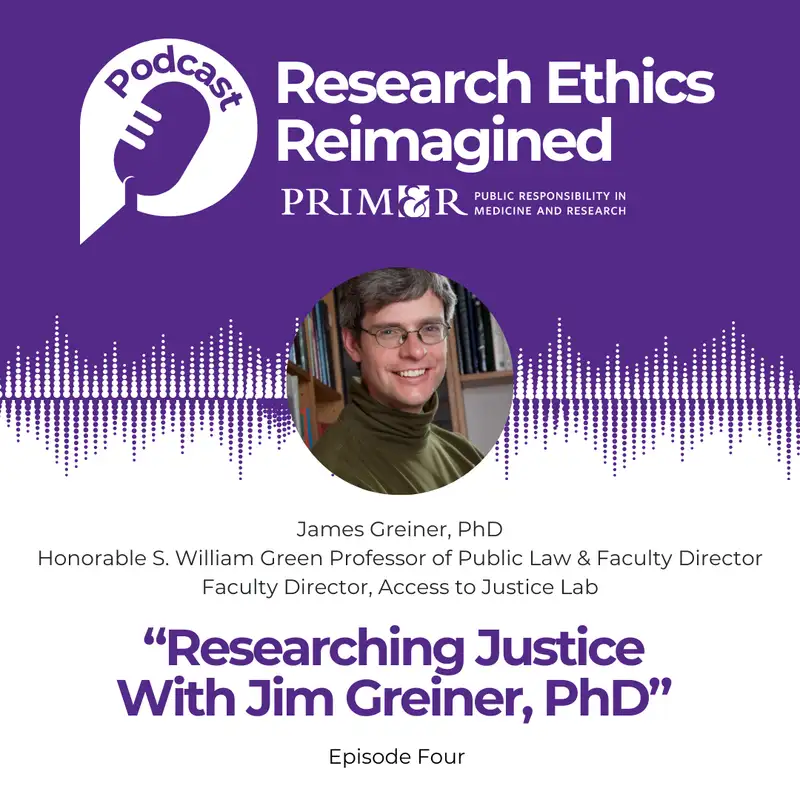
Welcome to Research Ethics Reimagined, a podcast created by Public Responsibility in Medicine and Research, or PRIMR. Here, we talk with scientists, researchers, bioethicists, and some of leading minds exploring the new frontiers of science. Join us to examine research ethics in the twenty first century and learn why it matters to you. I'm your host, Ivy Tillman. Let's dive in.
Ivy Tillman:Today, I am very pleased to have doctor Jim Greiner with us. Doctor Greiner is a professor at Harvard Law School and director of the Access to Justice Lab. The Access to Justice Lab is the only entity in The United States that focuses on randomized controlled trials in the legal profession. The Access to Justice Lab is conducting innovative work, implementing randomized field experiments to learn what works for individuals and families who cannot afford to hire lawyers. We were honored to have Doctor.
Ivy Tillman:Greiner deliver a keynote address during our annual conference, which was held most recently in Washington, D. C. During those remarks, he spoke about his work advancing equity and justice trust in science and research. At Harvard Law School, he teaches courses on civil procedure, expert witnesses, and access to justice. Before joining Harvard Law School in 2007, Doctor.
Ivy Tillman:Greiner completed his PhD in statistics at Harvard University and previously practiced law for six years, including three years with the Department of Justice. Thank you again, Doctor. Greiner, for speaking with us all in December at our conference and for sharing your thoughts with us today. So before we dive into the work that you're doing in the Access to Justice Lab, which is fascinating, I want to back up and really have you discuss how you define and envision justice and particularly justice practices in this space and legal empiricism.
Jim Greiner:Sure. So justice typically, the idea of justice typically comes from people who are in the system, either the participants or the people who are running it. What we try to do in the Access to Justice Lab is take those definitions, are surprisingly common across time and space and try to figure out what practices best meet those goals. There are a lot of differences across, you know, say jurisdictions, the jurisdictions, geographic jurisdictions about emphasis on different things. So some people are more willing to suffer certain types of costs than others, more incarceration versus more damage to, you know, family structures or to socioeconomic circumstances like jobs and housing and those sorts of things versus less of those sorts of things and and less cost to administer the system.
Jim Greiner:There are differences like that, but most people have the same goals. And what they mean by the justice system is a combination of the formal court system, administrative agencies that act a lot like courts. So administrative agencies that adjudicate eligibility for social security benefits, for unemployment benefits and those sorts of things. And then the laws that are generally governing behavior required to get people where they wanna be. So for example, wills and estate planning mostly is done outside the courtroom.
Jim Greiner:And a lot of it, if it ends up in court is typically just a administrative proceeding. You're just filing the paperwork and that's it. But you still have to adhere to those laws. So that's the justice system. What we hope in the justice system is it approximates some idea of justice, you know, goodness in the society of doing what the society wants.
Jim Greiner:Many would argue, including me, that our current system does a poor job of that.
Ivy Tillman:And so that's the work that you're doing, you know, Access to Justice Lab, or also known as the A2J Lab. We did some research, of course, from the website. And the Access to Justice Lab is designed to use empirical research to make The US justice system work better for everyone. So can you explain? I think you've kind of started to explain by what you mean by that, but really share where this idea for the Access to Justice Lab came from.
Jim Greiner:Yep. So the the idea is to try to transform the practice of law in The United States court system and the justice system generally into an evidence based field. Many people think, including me actually before I entered it, that because law is a profession, a traditional profession like medicine, that there would be the same dedication to evidence based thinking and defining evidence based thinking in the same way as say medicine. And in medicine for decades now, have insisted, for example, that new drugs and new medical devices cannot be marketed to the public. They cannot be recommended unless they undergo credible testing.
Jim Greiner:And typically that means a randomized experiment of the kind, again, that people are familiar with. And that's something that we understand and appreciate and live with and want in medicine. It has costs to it, severe costs in terms of people potentially, for example, dying while effective medication is unavailable while it's being tested. The problem is we don't know that it's effective until we test it. And there are many examples of medicines that were quite promising and that everyone thought were certain to work and ended up not being work or have backfired and caused harm.
Jim Greiner:And I thought, you know, entering the profession that the legal profession and the justice and the court system would be the same way that we would have the same dedication to evidence based thinking. Instead, which what we have in the legal profession is disdain, contempt, or bemusement for this type of evidence based thinking and the adoption of lots of practices that are justified primarily because we've been doing them for a long time, or they approximate things that we've been doing them for a long time, or because of their adaptations of longstanding practices that are adapted because of resource constraints. And so, you know, for example, it may surprise people that the idea of bail, which almost everyone has heard of, is not something that is hundreds of years old. It is a relatively, comparatively speaking, a relatively recent invention in The United States history. And it was adopted and put into place without an investigation into seeing whether it is effective at what it aims to do or whether the practices that were in place before bail were effective at what they intended to do.
Jim Greiner:In other words, all of the practices are adopted that way.
Ivy Tillman:Right.
Jim Greiner:And so the Access to Justice Lab's purpose is to try to transform that way of thinking and that way of doing things into something that is evidence based, where we have evidence about what works and what doesn't so that policymakers can make much better choices about the policies that they institute.
Ivy Tillman:Yeah. It's fascinating to consider kind of like evaluating these practices in a similar fashion that medical practices are evaluated. We're gonna get into really some of the reception that you've received from this work in a little bit, But how did you get interested in this particular type of research? Were you exposed to research? Sounds like I know the answer, but can you kind of walk us through your journey to this type of research?
Jim Greiner:Sure. It was remarkably accidental. I practiced law for a while, but not in trial courts that dealt with high volume cases. I was doing other type where a lot of these statistical techniques can be of most use. So you don't need a randomized trial to figure out, for example, whether a law is unconstitutional, that's not a scientific judgment.
Jim Greiner:And that's the sort of law work that I was doing as a practitioner. When I started to be an academic after going for a stats degree, I thought that it would be interesting to have some studies that were analogous to things that I had heard about in medicine. Never studied before except in stat school. You know, I studied some in stat school about how to do this. I thought it would be interesting to do some in law just like in medicine, but I thought that there would be hundreds or thousands of these sorts of studies in law the way there are in medicine.
Jim Greiner:And instead to give you an idea of what happened shortly afterwards, a law student and I spent about two and a half years looking for examples of these types of studies in law from, you know, throughout The United States history. And we found a total, depending on how you count them about 50. And there are probably 10 to 20 or 30,000 going on at any one time in medicine, at any particular moment in medicine. So the comparison, whereas what we're looking at is all of United States history, we can find about 50. So there were very, very few of them.
Jim Greiner:And so I said, well, maybe that's something that I can contribute to because I believe in evidence based And when I tried it myself, I encountered the hostility and the disdain and the rejection of this type of evidence based thinking. And that's a brick wall that I think is standing in the way of adoption of good policies. And when I see a brick wall, I like to punch through it. That was that was it was a challenge for me.
Ivy Tillman:And for those who don't have the privilege of actually seeing us on camera, Jim has a brick wall actually behind him. Actually has one
Jim Greiner:behind me. It's correct.
Ivy Tillman:I love that analogy. So why do you think there was or there is so much resistance and disdain?
Jim Greiner:So I struggle to find an explanation that distinguishes law and medicine because in the 1930s, if you had talked about the science of medicine, people would have looked at you like you were crazy. Medicine was not a science. Medicine made a conscious decision to try to transform itself into a science. Part of that was incorporating lessons from chemistry and biology and those sorts of things. But part of it was also a decision among the doctors to give up control about what works and what doesn't.
Jim Greiner:And they gave that control up to statisticians. And that was a wrenching decision that many in the medical profession fought, but those who were dedicated to evidence based thinking won that battle or at least partially won that battle. There was no such attempt in law, even though in again in 1930, there were occasional examples of using using randomization in law and drawing inferences about, for example, whether assignment to judge a versus judge b makes a big difference in criminal justice outcomes. That was a study that was done in the nineteen thirties, And it took advantage of the fact that cases were assigned randomly to judge A versus judge B. And so if you'd stood in 1930, you would not have known whether law or medicine was going to transform itself into an evidence based field.
Jim Greiner:One did and one didn't. And to go back to your question now, I struggle to distinguish between the two because all of the things that are quintessential about a profession, the idea of professional judgment being something very And the idea of having a statistician come in and tell you what works and what doesn't is threatening the idea of professional judgment, right? And what is good for each individual person as opposed to what works on average, which is what statisticians tell you. All of that's true in both fields. And so honestly, am the only thing that I can think of that distinguishes law and medicine is that rich people get sick in approximately sort of the same way as poor people.
Jim Greiner:And therefore, if rich people demand something that actually works, they will have institutions that protect their interests. Poor people do not encounter the legal system in any way resembling the way rich people do. There is no similarity between them whatsoever. And that's not a, you know, particularly lefty statement. That's just a statement of fact.
Jim Greiner:Right? And I don't think any anyone I think anyone of any political persuasion would would agree with that statement. And so that is the only hypothesis I've come up with. It's far from something that I call proven.
Ivy Tillman:Wow. That gives you a lot to think about, but I can definitely and you're right. It's not based in any political ideology. It's really a fact. And so in the systems that have been created and how individuals based upon our social constructs and socioeconomic factors, I'm sure play a part into into some of these decisions.
Ivy Tillman:So, you know, when you speak of this type of research and the website for individuals listening, when you get a chance, go look at the Access to Justice Lab website, because it does a beautiful job of kind of walking through the process. Jim, can you do that for us? Can you kind of explain like what types of studies are you currently conducting? What do they look like? How are they designed?
Ivy Tillman:Who's involved? How are the results disseminated? Are communities involved?
Jim Greiner:So basically the idea is that either we in the lab or that someone working in the justice system or someone working representing or speaking for people who encounter the justice system comes up with some idea that they think will improve matters. Or whether they it could be that they wanna test something that the justice system is doing right now. And we work with them to identify an alternative, both the thing that that they would like to test and the alternative. So what does that look like in practice? Well, it might look like, for example, providing self help materials to people who are seeking guardianship, an order of guardianship over an incapacitated adult.
Jim Greiner:So grandma can no longer take care of her assets. She can't make good financial decisions, we need to establish guardianship. That requires a court order, meaning a lawsuit. You have to file a lawsuit. In the criminal context, it might mean, for example, providing risk assessment instruments to judges who making bail decisions.
Jim Greiner:A risk assessment instrument is a quantitative tool that is designed to classify whether an arrestee is risky if released or is low risk if released. And there's more complicated than that, but that gets you the idea. And what we wanna find out is does that risk assessment instrument improve judge's decision making? And so once we've identified the idea we wanna test and the alternative, typically the alternative is business as usual, whatever it is that we're doing right now, then we work with local communities, with local stakeholders. And typically that's a lot of them.
Jim Greiner:So for example, in the criminal justice studies that I mentioned in the risk assessment example, that requires working with the sheriff's office, law enforcement, with prosecutors, with public defenders, with court administrators at the local level and at the state level. It requires work with, I guess, what you'd call county elders, whatever the governing body is inside the county or the city where you're working and then county staff. And what we've learned to our chagrin in some instances is it's not enough to convince the top of any organization. You have to convince the people who are doing the actual work. And so that's why I separate county elders and county staff, for example.
Jim Greiner:And we have to get everybody on board and the process takes months, sometimes years. And then we need funding because medical studies, these studies are slow and they are they do require money for staff in order to produce the study, and we set up a system whereby we try to have cases or people coming in to a particular point. In the bail example, it would be when they are arrested and and facing a judge for the first time to see what bail will be set. In the, self help materials example, for guardianship, it would be when people present at a legal services provider's office. And we randomize them to one treatment or the other treatment, usually to the new the new idea or business as usual.
Jim Greiner:And then we follow everyone according to the outcomes that are defined upfront, again, in conversation with stakeholders and with the community. For example, in the bail study, what does the community and the stakeholders care about? They care about failure to appear, whether people come back to court. They care about re arrest or recharge or reconviction for new potential new offenses that occur during if if people are released during the predisposition period, especially if those are violent. They care about the number of days of incarceration.
Jim Greiner:How many to how many days are people incarcerated? And the reason for that is both expensive to the county, but potentially, equally as perhaps more important, incarceration, we think, is bad for the individual incarcerated, bad for the family, bad for the community. It prevents people from doing things like getting jobs, having relationships with their children, with their families. For some people, temporary incarceration might, I emphasize might, in my view this isn't proven yet, but it might turn out to be true, might be a life changing positive experience. Right?
Jim Greiner:Maybe they get access to treatment or to counseling or whatever it is they didn't have before, but again, we know it's something that we can try to assess. And so we follow outcomes for everyone, and that takes a long time too, which is one of the reasons why these, studies are slow and expensive. And when we produce the results, we report back to stakeholders, and we try to publish in academic journals, and we try to attend conferences where people of the type of folks who do this sort of work attend and let them know what our evidence shows, and hopefully, they take it into account. And the last part, in particular has been a real challenge for the lab. We have we have had real challenge getting buy in, even for people who have participated in the study, and that's something that is just that human beings, when you make a decision and start doing something day to day, it's very hard for one to accept the idea that what one is doing may be ineffective or may be counterproductive.
Jim Greiner:It may be producing the opposite of the desired aim. That is a very difficult thing for people to accept, particularly professionals who say, I have special training. I have specialized experience. The world thinks I'm cool because I have degrees and that sort of thing. And and now you're telling me that my professional judgment is dead wrong.
Ivy Tillman:Yeah. I can imagine so. I'll get into when we start talking about like the IRB process that you went into. If we have time, I want to ask about like the informed consent process associated with this type of work, because I think that's fascinating and it may look a little bit different than what we're accustomed to, even in medical or social science research. But what surprised you about some of your own findings from some of your research?
Jim Greiner:Sure. So I have given up on being able to think that I can predict what the research is gonna show because I've been wrong so many times that it's just silly. To give you an example, we recently did, as I mentioned, bail a a study about provision of risk assessment instruments at bail. I thought they would improve criminal justice outcomes, the providing the risk assessment instrument versus not providing it. I thought at worst, how could it possibly be harmful?
Jim Greiner:Of course, has to improve. It's better it's better information. So far, doesn't. So far, it has no effect whatsoever, and it's unfortunate because producing the information, getting it into a type of format that a judge can use, and providing it to the judge, educating judges on what the information looked like and how to interpret it. That's not free.
Jim Greiner:That can cost counties hundreds of thousands of dollars, millions over time. Even if you try to automate it, it requires a lot of people to do a lot of computer programming. And so far, again, this isn't final, but so far, we're not seeing any effect, good or bad. Many people had thought those risk assessment instruments would cause bad racial effects, that they would increase the racial, tinge, call it, that exists within our criminal justice system. Didn't do anything.
Jim Greiner:To give you another ex from something that I did not predict, there was a we recently published recent, in this case, it was about three or four years ago, a study of the effectiveness of a pro bono matching program for folks who want to, seek simple divorces. And what that meant was folks who had, very little in the way of income and assets, virtually nothing typically, and or wanna get divorces, would call this service and say, have no basically no assets, very little in the way of income. I can't hire a lawyer. Can you match me with a lawyer who's willing to volunteer to help me with my divorce? And the the matching service that had a stable of attorneys that it could call on typically had enough attorneys to provide lawyers to about 15% of those who called.
Jim Greiner:That was completely overwhelmed. And so we randomized Wow. To whom they provided. And and I gotta tell you, I thought that matching service would not be particularly effective. It often took the matching service months to come up with a match even when we randomized people to receive a match.
Jim Greiner:It took them sometimes months. And the process was not supposed to be complicated because there were no assets and there were no children. There's no child custody issue. For the overwhelming majority of people, it's just, and this is almost a direct quote, I don't wanna be married to that bum anymore. In other words, I just don't wanna be married.
Jim Greiner:Right? Or I wanna remarry and I can't because I'm still married. Right. Or something like that. That's all they were seeking is just the piece of paper saying my marriage is over.
Jim Greiner:In some instances, the spouses had not seen each other for a decade, and they needed just a piece of paper. And that pro bono matching service turned out to be wildly effective. And it was quite surprising to me because, again, it was not supposed to be a complicated thing to go get this piece of paper, and yet it apparently was. And so those are a couple of surprises.
Ivy Tillman:Interesting. Interesting. That's akin to the process. When you go in and you hypothesize that that some system may work that it doesn't or some or one would be a little bit more simple and it's more complicated, but there are positive results. That is definitely akin to the scientific process that many of our researchers experience.
Ivy Tillman:So let's turn back to the Access to Justice Lab and some of the history behind it. So I'm going to read this and then we'll ask a question on the back end. So the history of the Access to Justice Lab notes that for more than a century US legal and adjudicatory practices have reflected an ethos of professionalism, and which individual lawyers and judges purport to make irreducibly complex judgments about each client's or litigant's legal needs and the merits of their claims. The belief is that only a lawyer knows what's best for a client and the only person a lawyer should listen to about their client's legal needs is another lawyer. As a result, law currently recognizes only two sources of truth about what works and what doesn't.
Ivy Tillman:The pronouncements of legal elites and each individual lawyers or judges own personal experience. With that in mind, when you present your findings, what happens when the data tells a story that the community does
Jim Greiner:not? Yeah. That's quite a mouthful. Even just reading it, it's quite a mouthful. So just a quick explanation.
Jim Greiner:The idea that each case is irreducibly complex, What that means, and I hear this constantly from lawyers, is that each individual is their own universe. And there's no point in comparing one case to another case in any way to another one person to another person in any way. You can't learn anything about person a from looking at person b's experiences. Or you can only do that if you're a professional. There's no way for a statistician to come in and measure anything.
Jim Greiner:Only a professional can do it. And so if that were true, for example, if each human body were irreducibly complex, there would be no point in studying whether penicillin on average helps combat is an effective antibiotic. Right? Because each person's body is so different that there's no point in making any inferences. Of course, we know that's not true, and we know it's not true in the case of, that I mentioned, of a lot of simple divorces, that they are people have similar aims, and in some way, they have similar circumstances.
Jim Greiner:Of course, each one is a little bit different, just like everybody is a little different. So anyway, we asked what the reaction is, and as I mentioned, we've really struggled in getting people to buy into our research findings, even people who have participated in the studies themselves. And we attribute that to the fact that this type of thinking is quite alien to the legal profession. It's quite it's quite different from the way we even I teach in law school because people come come to law school in the first year, especially, and and expect to see a certain type of education. And I do provide that education because I because they need it for their eventual practice if they're gonna practice.
Jim Greiner:On the other hand, I try to show them also there's there are different ways of thinking about this. But we have, for example, struggled to to suggest to folks that they may wanna consider reconsider practices that they are currently implementing that we have found to be, in some instances, mildly harmful, and reconsider, practices that, are expensive but have no benefit. Try to find out why it is that a particular expensive practice works and take away the obstacle. For example, in the divorce study that I mentioned, where the idea is the lawyer is having a big effect on whether folks get a divorce, the lawyer shouldn't have a big effect on whether people get a divorce. That divorce proceeding with no assets, no income stream, no child custody, no domestic violence in at issue.
Jim Greiner:There may be those things in the marriage, but they are handled in separate legal proceedings. So they're not at issue in whether someone gets a divorce. You can just get the divorce and be done. That should not be a lawyer should not make a big difference there. That is a indication of a severe access to justice problem, and the idea should be take a look at what your system where are the hurdles?
Jim Greiner:Or actually, the hurdles in this case are quite high and they are unnecessary. And so the example that we cite in that particular paper that everyone can understand is, for example, there was a particular moment in the divorce proceedings when a pro se litigant, meaning someone without a lawyer, had to find and use an old fashioned typewriter. No. I'm not I couldn't find one. I don't I I've actually sat down and thought, if I needed a typewriter, where would I go?
Jim Greiner:I don't have a clue.
Ivy Tillman:No.
Jim Greiner:I might start with a local library, but I don't think they have one either, unless it's locked up in a glass case as the museum exhibit. That was an example of something that local practice, even if it didn't formally by law required, effectively required because there was a high not certain, but high degree of probability that the legal piece of paper that you needed to send to the court would be rejected if you didn't have access to a typewriter. Wow. And so that's the kind of examination that we hope our studies will engender, and again, this is not this is something that we that we still struggle with at the lab.
Ivy Tillman:Absolutely. So when we talk about your presentation at our annual conference in December, you spoke about conducting research with prisoners particularly. So can you share about the work you've done, the research with prisoners, but also how you found the process, the regulatory IRB process for getting to that approval, your experience with that?
Jim Greiner:Absolutely. So just to be clear, the regulations, it's actually section three zero three c, I have it up in front of me, defines prisoners as anyone who is incarcerated at any point in the criminal justice system. So a prisoner isn't someone in a prison because at least in the legal system, we think of a prison as something where people or someplace where people go after they are convicted, and a jail is somewhere people go before they're they convicted or if they're convicted of only something mild. In other words, jails typically are temporary local institutions. Prisoners are for longer term residents.
Jim Greiner:But the regulations, I think probably properly, don't make that distinction. If you're incarcerated Mhmm. Or even if your freedom is limited in a severe way, and this is part of IRB training. If you are in a hospital Mhmm. And a guard is standing outside your door and won't let you out, that's an incarcerated individual.
Jim Greiner:Right? And and so there's it's a very broad range, and currently, the regulations you can tell are written with the assumption that only medical research is being done with quote unquote prisoners, with prisoners under this definition. And you can tell that because, and again, I have the provision up in front of me, section three zero five a three, so 45 CFR, forty six three zero five a three, requires an IRB to decide whether the risks involved in the research are commensurate with the risks that would be accepted by nonprisoner volunteers. Now that makes total sense if you're talking about medical research. Right?
Jim Greiner:Because there's nothing frequently at least, there is nothing that is relevant to the research about the fact that people are incarcerated. You're just you just need human bodies, and you need human bodies to to undergo different forms of treatment and see which one is more effective, and your assumption is the human bodies in prison and among incarcerated individuals are similar enough to those outside that we can still learn something. I don't know how to apply that subsection if what I'm trying to do is see if there are safe alternatives to incarceration. The only people who are interested in alternatives to incarceration are those who are incarcerated. If, for example, what I'm trying to do is test an intervention that might, allow municipality to reduce its reliance on incarceration.
Jim Greiner:What I am apparently instructed to do under this regulation is see whether people would want, for example, to be bailed out of jail if they are not incarcerated, or if they are not in jail, or if they have never been arrested. And I find that difficult a difficult thought exercise. More broadly, the assumption that only medical research occurs is built into other aspects of the regulations, not it's most stark and obvious in the prisoner regulations, but it's built in elsewhere.
Ivy Tillman:Mhmm. Mhmm. And so I think you've answered my next question, which is really if you could inform some revisions, particularly to the provision around prisoners or even the definition. Because as you were speaking and recalling your experience, I was thinking about past experiences that I've had with researchers who were non clinicians who wanted to do research with incarcerated individuals and even just the definition and where the individual was located at the time really mattered. And IRBs grapple with how to how to review this type of research and facilitate it while maintaining compliance with the regulations.
Ivy Tillman:So, you know, what kind of suggestions would you have as far as revisions to our current regulations?
Jim Greiner:Yeah. First of all, let me just say to Seb, I I I think history has taught us, forcefully and, in a gruesome way that we need regulations. That one doesn't there are just too many horrible examples of inhumane treatment by researchers of study participants of acting, as you mentioned earlier, without consent, and the idea of consent without acting with adequate information. And regulation is necessary. Oversight is necessary.
Jim Greiner:It it is no good to say these are educated, highly ed you know, educated people. They're professionals. We can trust them. That was true of the Nazis. That was true of the folks who perpetrated Tuskegee.
Jim Greiner:That was true of true of folks who perpetrated Willowbrook. All of the horrible story. What are the what should regulations around incarcerated individuals look like? I don't have complete answers, but I think one thing, to do is, if you are going to write a set of regulations that is specific to incarcerated individuals in The United States, which apparently, again, sections three zero three and three zero five are are are designed to do, you need to, incorporate a more thorough understanding of how incarceration works in The United States and what different stages of the criminal justice process are doing and designed to do. You need to make hard judgments, for example, about whether an individual on parole whose activities are strictly are are are strictly, regulated, but are not but the individual is not physically incarcerated at all times.
Jim Greiner:Then there are some people who are halfway, thus the term halfway houses. You need to make judgments about them, and that's just definitional. That's just to figure out what you're gonna require of them. You also need, I think, to be more receptive to the idea that research that is designed to I I guess this is the academic term, interrogate, to investigate current practices is high risk in the sense that the outcomes are important, but it is therefore all the more important to do. So for example, if we have what we're trying to figure out is whether incarceration is necessary or whether we can decarcerate, that will mean doing a study where the the intervention, some intervention like a risk assessment instrument or or something like that will change who was incarcerated and who isn't.
Jim Greiner:If it doesn't, there's no study, and and that is a big consequence. That is an important consequence. There is no way in my view to characterize that kind of study as low risk. On the other hand, death is a big consequence, and the and we routinely implement studies in which the outcome variable is death within five years. That's a typical cancer study, or a major heart attack or something like that, a major cardiac event within high is within within five years.
Jim Greiner:That is a typical heart study. And so the fact that the consequences are are big or salient, are important is a reason to pursue the credible research, the rigorous research, not a reason to avoid it. And the fact that the circumstances are unfamiliar, in other words, we say, my goodness, we're randomizing incarceration. That's a terrible idea because we've never done it before, because we've only done it very infrequently. Whereas we randomize medicine that can kill people or save their lives all the time, and that's fine.
Jim Greiner:That's not convincing. The fact that that that what we're gonna need to do is to say, wait a minute, these are big circumstances. These are big outcomes. These are important outcomes in people's lives. These are real people's lives, but that is all the more reason to do the research because we don't wanna be incarcerating people unnecessarily.
Jim Greiner:And on the other hand, for some people, and I'm not taking a position on this personally, for some people, we don't wanna let people out of jail who we think are have a very high probability of of committing some horrible crime. There are some people who who think that way too. Right? And what we wanna know is to and and provide them with strong information to allow policymakers to to make democratic judgments. Incarcerated individuals are different, and if the idea is to try to see whether we can whether we need to dispense with or whether we need to increase or rightsize incarceration, we need credible evidence.
Jim Greiner:Mhmm. So
Ivy Tillman:my last question relates to a concept that you discussed at the conference, which was fascinating to many of us. And you mentioned the concept of thinking of IRBs as like a court, but also having this level of transparency to the determinations and precedent that's been set. Can you describe that that concept more and what that could look like?
Jim Greiner:Sure. So I think the problem that this is that this idea line of thinking is designed to address is inconsistency in decision making within an IRB, and then inconsistency in decision making across different IRBs. The latter problem across IRBs didn't used to be, I'm guessing, put it this way, didn't used to be as big a deal until scholars started to make routine across institution collaborations. So those are those are just run of the mill these days. It is the exception as opposed to the rule that one scholar will pursue one IRB one operation that requires IRB approval.
Jim Greiner:It's much more likely that there will be multiple investigators and they will be at different institutions, and therefore coordination is something that has to happen. And what I have experienced and what I think others have, including, folks, you know, who work in IRBs, is that there are differences in how folks approach the same study, or there are differences in how folks approach two studies that are essentially the same within an IRB. And I've had both experiences. I've had experiences where we where we it was essentially the same study for all intents and purposes for IRB. We just changed the language in some letters that we were sending out to folks who had been sued in debt collection.
Jim Greiner:From one study to the other, and two IRB officers reacted quite differently, and it had nothing to do with the language in the letter. The one that the second one had it was not citing the language in the letter at all, which is simply saying this study shouldn't have been approved to begin with. And in and in the cross institutional context, one IRB said that this is not human subjects research and therefore doesn't even need to go in undergo approval. The other one said this needs to go to the full board. We can't approve it at the staff level because we think it's high risk.
Jim Greiner:I happen to, by the way, to think in that instance, the second IRB was correct, and I wanted them to approve the research. It would have been much easier if if for me, if they had said it's not human subjects research, but it was definitely it was high risk, and it needed to go through full review. So what does that mean? There are things that the legal system has partially at least figured out to try to address this kind of inconsistency. And you mentioned one is the idea of precedent where there can be where there is some sort of summary of a IRB application and then the decision, and the reasons for the decision are written down.
Jim Greiner:And the the underlying documents are accessible to the to the community so that we can see what it was that affected the decision maker's process and say, they did this before and this is similar to that. Of course, it won't always be similar, but that's the point is to make a judgment. And then other institutions can look at the same thing, so they can that was also be available to other institutions. In other words, if university a says deals with one, case and a pre went out of study in a in a particular way, then maybe that's a reason for university b to think that they should do the same. Other ways of doing it are to have what amounts to in the court system appeals process so that there is some higher level IRB.
Jim Greiner:I don't know what you'd call it. Appeal appellate IRB, appeals IRB. And what they would do is, again, issue reasons for their decisions that other IRBs could then look at and make and draw analogies to. And say, that's decision is this way, then we should probably make the same sort of decision or make a different decision. The fact that those ideas might be useful to increase uniformity within and across IRBs, that's what courts do.
Jim Greiner:They look at individualized circumstances, and they make they take complicated and vague regulations, sometimes regulations like the current ones that are not particularly well adapted to a new fact pattern, and they make decisions. That's what courts do. Administrative agencies do the same when they're acting like courts, which is why I'm just calling them courts. And on the basis of those sort of published decisions, or decisions that are accessible to the public, the, people can have greater uniformity and predictability, in in what IRBs will will, will approve. And that also, by the way, that can then allow researchers to structure studies upfront in order to anticipate what potential objections will be, and that I think reduces workload.
Jim Greiner:I think if we can solve speaking for the we here as a research community, if I if we can solve problems upfront, we want to. Nobody likes for the IRB process to to to take months. And, if we can anticipate and solve problems in the in constructing the field operation based on knowledge of how people have ruled before and therefore how they're likely to rule in the future, we can potentially save everybody, including us, an awful lot of work.
Ivy Tillman:Wow. So how has that I'm sure you receive a lot of feedback at our conference. When you are talking about this concept, how has that been received?
Jim Greiner:So I think a lot of people have said, sounds great, but how would we do it? And I think there are ways to do it, to begin doing it, put it this way, even at low cost. I mentioned that there are information aggregators who make it their business, being folks like Lexus and Westlaw and Bloomberg. What they like to do is market the fact that they have access to types of decisions or to things that people want, and therefore, if you pay for their service, if you subscribe to their service, they'll you'll get access to their information. And so even simply having IRB officers write a one or two paragraph summary of the study and then a one paragraph decision, about it.
Jim Greiner:That would be a first step, and again, I think if those were made in some way accessible to an information aggregator, the information aggregator would do all the rest of the work, and, because they would then accumulate the information and go to universities and basically extort us for subscription fees, which is exactly what they do, and we would pay it. Right. And say, you want access to this IR you know, these IRBs like, IRB library, you gotta pay the fee. Right? And I would go to the university, I'd say, pay the fee.
Jim Greiner:Right? And so that I think is a one potential sort of free step that you or not entirely because you'd still have to write the paragraph. But again, I think this is something you would tell me. Well, I think this is something it would not be hard to do having finished a file. You probably got an idea of what the file looks like and a couple sentences about why you're approving it at the level you're approving it or why you're sending it onto the floorboard or something like that.
Jim Greiner:Again, I think this is something you just sit down and tap out. So that would be a first step. I think there are other things like an appeals IRB would require resources, and but I think the publication part and the accumulation information part, you just take advantage of market forces.
Ivy Tillman:Fascinating. Fascinating concept. I would love to continue that conversation. So thank you. Thank you, Jim, for your time and really opening our eyes to a discipline that can definitely benefit from collaboration with our ethics professionals more.
Ivy Tillman:Thank you.
Jim Greiner:Ivy, again, thank you so much for the opportunity.
Speaker 3:Thank you for listening to Research Ethics Reimagined, a podcast created by Primer and produced by Syntax in Motion. Please subscribe and share with your friends and colleagues. To learn how to become a member of Primer, please visit us at www.primer.org. Be sure to join us next month as we continue our conversation with scientists, researchers, bioethicists,
Jim Greiner:some of
Speaker 3:the leading minds exploring new frontiers of science.